One hand
You play one deal. Win or lose — that is the format. No carry-over between sessions.
The single-deal format. The fastest decision profile in the rummy family — and the sharpest variance.
Points rummy collapses an entire session into one hand. You sit down, you draw 13 cards, you either declare first or you pay the losing margin. There is no second deal, no pool, no slow bleed. The format is a clean test of a single decision tree under compressed pressure.
It is also the most variance-heavy variant in the rummy family. One bad draw costs you the stake. A player who wins three in a row is not three times better than the table; they have been dealt a sequence that compressed their skill edge into a small number of hands. Read this format with humility about what it actually measures.
You play one deal. Win or lose — that is the format. No carry-over between sessions.
Each table has a fixed rupee value per point. Winners score zero; losers pay the ungrouped card count.
A single hand of points rummy runs three to eight minutes depending on table speed. Total session time is bounded by your hand count.
One hand has the highest variance-per-minute of any rummy variant. Sessions feel streaky; they are.
Sort your hand into suits. Look for natural runs before you look at the joker. A pure sequence with no joker in your first five is the strongest opener you can have. If you don't see one, plan to drop.
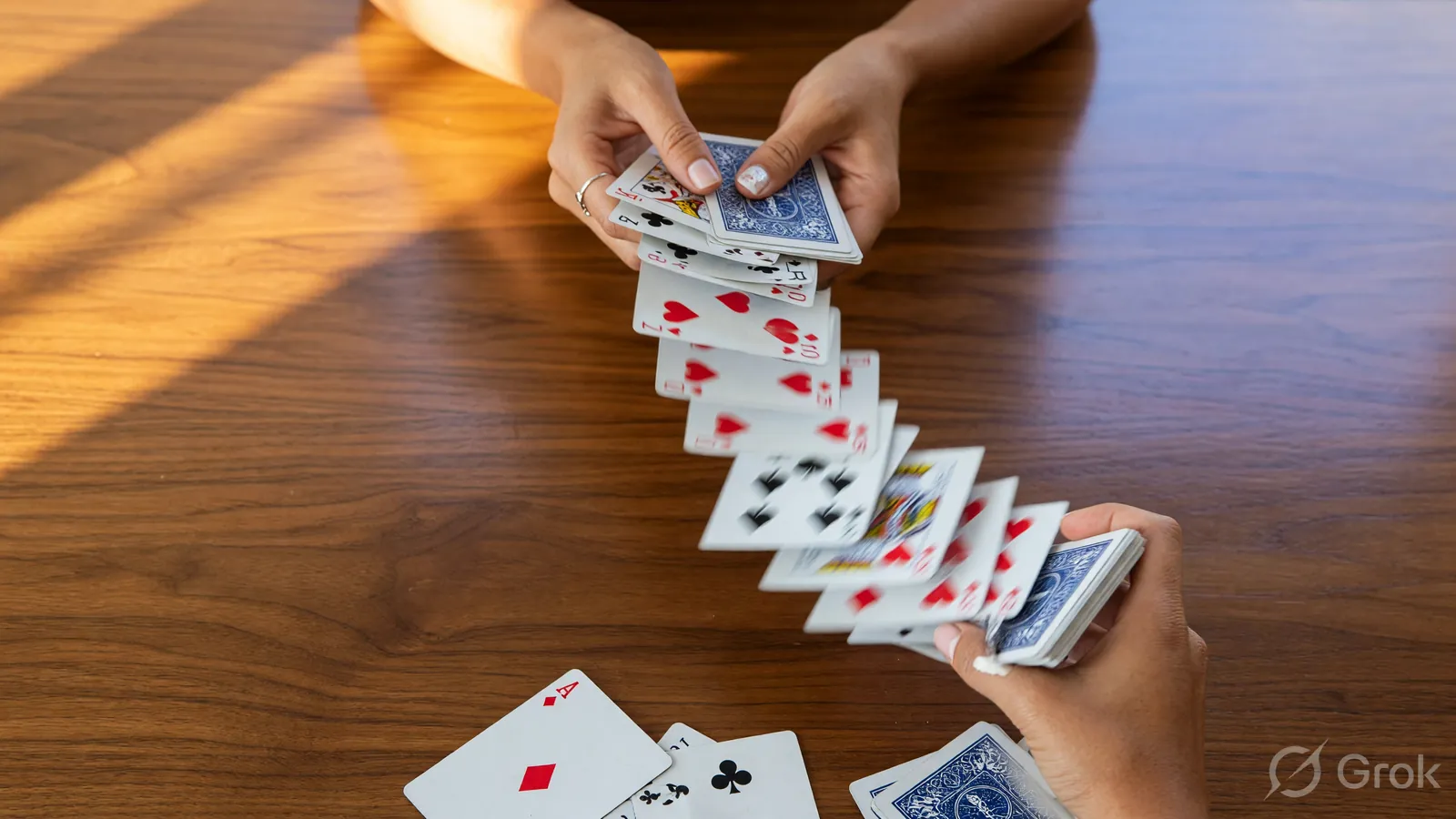
Each draw changes the math. Pick from the closed deck when you need a specific card; pick from the discard pile when the visible card completes a run or set. The discard you leave tells the table what you have — pick accordingly.

Most operators cap losing points at 80 (the card count of a full hand plus drop penalty). Some cap lower. Read your table's max before you join — a single full-hand loss at 80 is the worst case.
Points rummy drop values are typically a flat 20 or 25, not the ladder used in pool. Confirm before assuming a 20 first-drop when the table allows a 25.
Some operators allow dropping only before picking a card; others allow dropping on any turn before a meld. This is the rule that changes whether a bad draw costs you 20 or 80.
A session of points rummy ends when you stop. There is no table pressure to keep playing.
Three wins in a row is not evidence of edge. Three losses in a row is not evidence of failure.
The temptation to chase a single loss is the real threat. Session caps and walk-away rules matter.
The skill edge is small and lives in the discard pile. Most of the outcome is the draw.
Points rummy is the short story of the rummy family. One deal, one settlement, one clean feedback loop. That is why coaches and serious hobbyists still use it as a drill format even when their preferred money game is pool. You can test a discard theory twenty times in an evening without carrying elimination math across the night.
The trap is treating the short horizon as permission to gamble. Because each hand is independent, tilt resets are easy to skip. Players reload, rebuy, and re-enter without the emotional cooling that a long pool loss sometimes forces. The editorial fix is a hand budget: decide the number of points hands before you open the lobby, and stop when the counter hits zero.

A points hand without a pure sequence is a liability that compounds every draw. Build the pure before you decorate the hand with jokers. Jokers are accelerants, not foundations. Readers who reverse that order win highlight-reel declarations and lose quiet bankrolls.
Watch the open deck like a public ledger. Every pick is a sentence about the taker's shape. If two seats fight over the same suit connectors, change your discard language immediately — even if it slows your own finish by a turn.
Group by suit and potential pure before you admire face cards. Pretty hands that lack a pure are still losing hands.
Decide the turn number at which you will middle-drop if the pure is not real. Write it mentally as a rule, not a feeling.
Track the first three open-deck picks. Early fights over a suit are stronger signals than late panic picks.
If a single full-count loss bothers your stomach, the stake is too high for a format designed for repetition.
Stake sizing in points should be boring. Points is a volume game; volume multiplies both edge and error. Keep the unit small enough that you can finish the planned hand count with a steady pulse.
Some operators run turbo timers that punish thoughtful play. If the timer is shorter than your natural sort-and-plan rhythm, either practice offline with a stopwatch or move to a slower room. Speed is a skill, but forced speed is just a fee dressed as excitement.
When you review a session, do not only catalog winning declarations. Catalog the first-drops you skipped and the open cards you gifted. Points mastery is mostly subtraction: fewer stubborn holds, fewer informative discards, fewer rebuys after the plan said stop.
Pool, points, deals and Gin — same cards, different math.
Open the variant map →Every step of a beginner hand, with the cards on the table.
Read the walkthrough →The two levers that keep points rummy from quietly costing more than you intended.
Open strategy →Most platforms let you observe tables before joining. The five minutes you spend watching is the cheapest lesson on the site.
Readers who return to this page after a live session should bring one artefact: a screenshot, a drop decision, or a cashier timestamp. Abstract rereading helps less than comparing your artefact to the checklists above. The goal is not to memorise every paragraph. The goal is to change one behaviour in the next session and measure whether the ledger feels cleaner.
If a paragraph here conflicts with your operator’s live help center, the help center wins for table mechanics. This desk wins for framing, safety habits, and questions to ask. Keep both tabs open the first time you try a new room. Confusion is expensive; cross-checking is cheap.
Share documented corrections with the editorial desk when you find drift. Skill-game products move. Editorial pages must move with them, and that only happens when careful readers send primary evidence instead of rumours. Thank you for treating your bankroll and your attention as finite resources worth defending.
A final reminder on pace: nothing on this website requires you to deposit today. Observation tables, offline drills, and responsible-play tools are complete activities. Real-money play is optional infrastructure for adults in permitted contexts who already have spare money and spare time — not the other way around.
Readers who return to this page after a live session should bring one artefact: a screenshot, a drop decision, or a cashier timestamp. Abstract rereading helps less than comparing your artefact to the checklists above. The goal is not to memorise every paragraph. The goal is to change one behaviour in the next session and measure whether the ledger feels cleaner.
If a paragraph here conflicts with your operator’s live help center, the help center wins for table mechanics. This desk wins for framing, safety habits, and questions to ask. Keep both tabs open the first time you try a new room. Confusion is expensive; cross-checking is cheap.
Share documented corrections with the editorial desk when you find drift. Skill-game products move. Editorial pages must move with them, and that only happens when careful readers send primary evidence instead of rumours. Thank you for treating your bankroll and your attention as finite resources worth defending.
A final reminder on pace: nothing on this website requires you to deposit today. Observation tables, offline drills, and responsible-play tools are complete activities. Real-money play is optional infrastructure for adults in permitted contexts who already have spare money and spare time — not the other way around.