2 to 6
Indian rummy is played with 2 to 6 players. With 5 or 6 players, two decks are used and jokers become a more meaningful resource.
A worked walkthrough with the cards on the table. Plain English, no jargon, no assumptions about what you already know.
This chapter is for someone who has never played a hand of rummy, or who has played a few hands and wants to be sure the rules are clear. We walk through one complete deal of 13-card rummy from the cut to the declaration, with the cards visible at every step.
There are short cuts you can take later (which cards to track in the discard pile, when to drop, how to read a joker), but for the first three hands the only thing that matters is the loop: draw, arrange, declare. Once that loop is in your hands, the rest is refinement.
Indian rummy is played with 2 to 6 players. With 5 or 6 players, two decks are used and jokers become a more meaningful resource.
Two standard 52-card decks are shuffled together. One or two printed jokers are added, plus a wild joker pulled at random.
After the cut, the dealer turns one card face up. Whatever its rank, all four of that rank become wild jokers for this deal.
Each player receives 13 cards, face down, one at a time in rotation. The next card is placed face down as the closed deck; the card after it is turned up to start the discard pile.
On your turn you take one card: either the top of the closed deck (face down) or the top of the discard pile (face up). The choice is yours and signals your intent. A closed-deck draw is opaque; a discard-pile draw reveals what you needed.
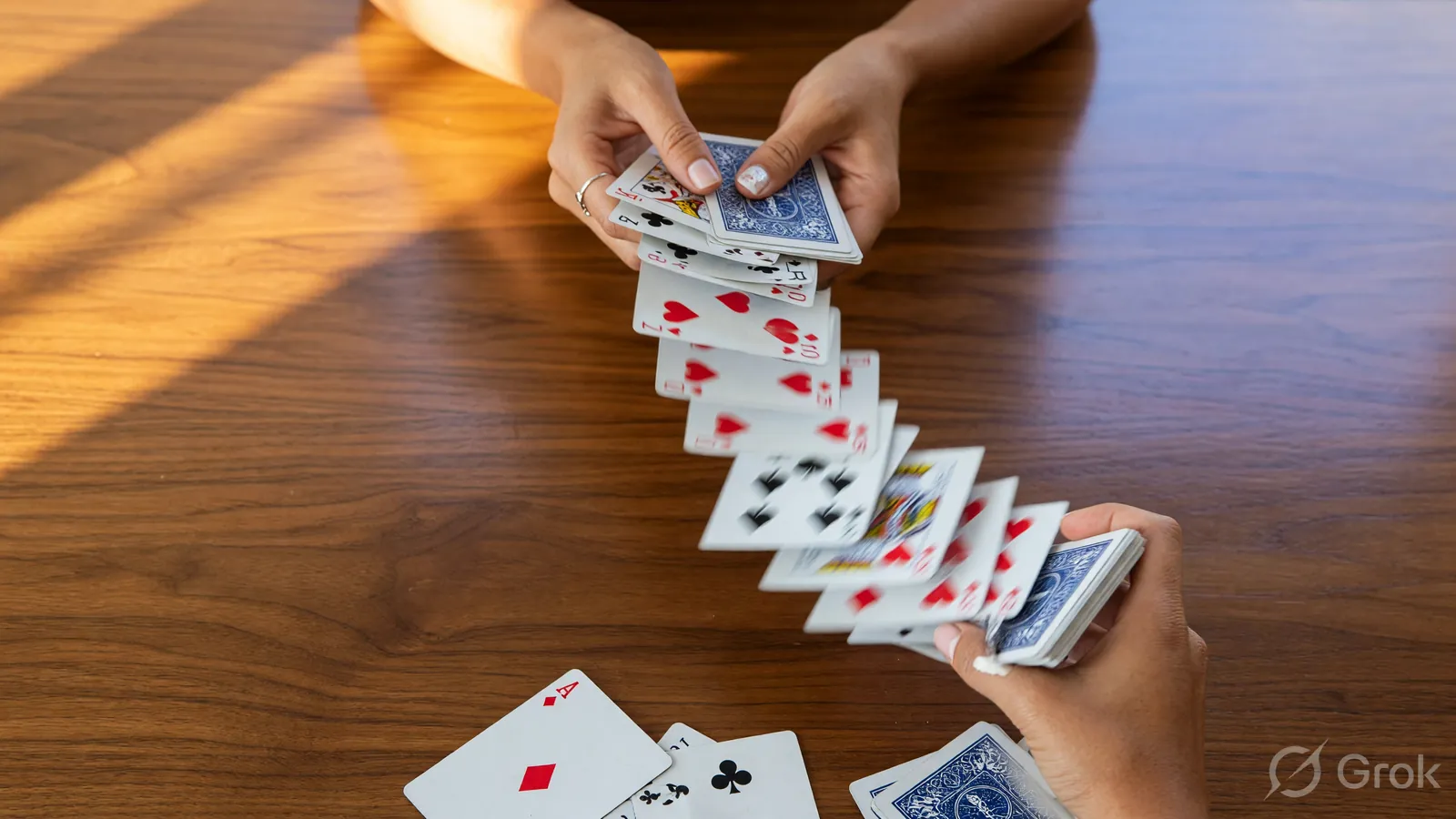
Once you have drawn, arrange your 14 cards to maximise melds. Two sequences and at least one set or third sequence is the goal. One of the two sequences must be pure — no joker.

End your turn by discarding one card face up onto the discard pile. The card you throw is the signal you give the table about what you do not need. Pick a throw that is least useful to opponents.

| Meld | What it is | Joker allowed? | Example |
|---|---|---|---|
| Pure sequence | Three or more consecutive cards of the same suit, no joker. | No | ♥ 4 ♥ 5 ♥ 6 |
| Impure sequence | Three or more consecutive cards of the same suit, with one or more jokers. | Yes | ♠ 7 🃏 ♠ 9 ♠ 10 |
| Set | Three or four cards of the same rank, different suits. | Yes | ♦ 9 ♥ 9 ♣ 9 |
| Invalid declaration | Two sequences are required; one must be pure. Anything less is a losing declaration with the maximum score. | — | One pure + scattered high cards |
♥ 3 ♥ 5 ♥ 6 ♦ 7 ♦ 8 ♦ 9 ♠ 4 ♣ 4 ♣ 7 ♣ J 🃏 Q
The joker is the printed joker (any suit). The wild joker in this deal is 8, so ♦ 8 ♠ 8 ♥ 8 ♣ 8 are also jokers.
Hearts: 3, 5, 6. Diamonds: 7, 8, 9 (with the 8 as wild). Clubs: 4, 7, J. Spades: 4. Printed joker: Q.
You have one pure sequence started (♥ 5 ♥ 6). Need one more card of either rank to complete.
Using the 8 as a wild joker, you have an impure sequence of diamonds. Combined with a third set you can declare.
Most first-month losses in rummy are not mysterious. They come from a short list of habits that feel productive while they quietly print points for the rest of the table. The good news is that each habit has a plain replacement you can rehearse offline with a physical deck before you risk a deposit.
This section is a repair manual, not a scolding. If you recognise three or more of the traps below, pick one to fix this week. Skill compounds when the repair list is short and repeated, not when you try to become a different player overnight.
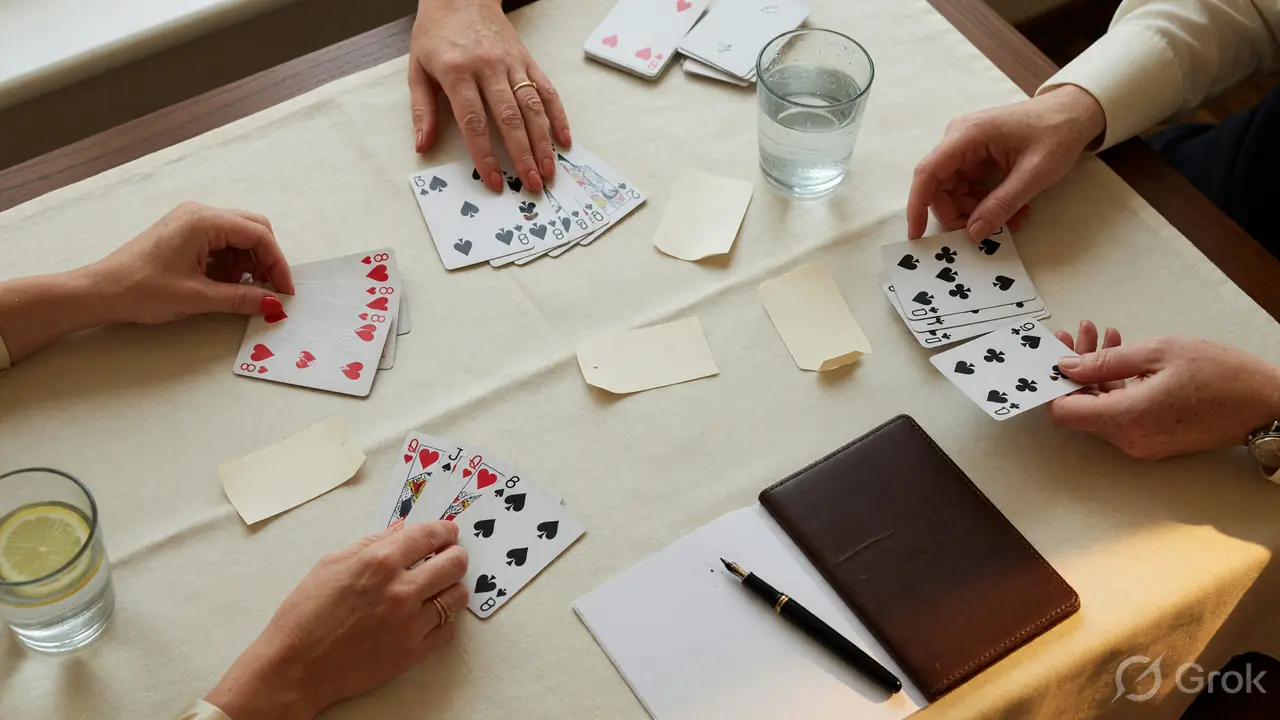
Beginners love jokers and face-card sets because they look like progress. Without a pure sequence, that progress is cosmetic. Sort for the pure first on every hand for thirty days. If the pure is not real by your pre-set turn number, drop. The discipline feels boring. Boring is how bankrolls survive January.
Trap two is informative discarding. Throwing the exact connector an opponent just failed to pick is a gift receipt. When unsure, prefer middle cards from suits nobody is fighting over, and never break your own pure to “look active.”
Deal thirteen cards, race a timer to identify pure potential, then reshuffle. Fifty reps beat any tip video.
Play six practice hands and write one line per discard: safe, risky, or informative. Patterns appear fast.
Force a first-drop on any hand without pure shape by turn three. Muscle memory matters more than pride.
Watch a friend's practice table and only log open picks for ten hands. Reading improves without stake pressure.
Once the drills feel automatic, return to the turn-flow section above and replay a single hand in slow motion. Name each action out loud: draw, evaluate pure, evaluate drop, discard. Speech slows the hand just enough for judgment to catch up to impulse.
Operators differ on joker rules, printed jokers versus wild from the open card, and whether sequences can wrap. Always confirm those lines in the room’s help page before you treat a practice habit as universal law. The grammar is shared; the dialect is local.
If you are teaching someone else, sit behind them for a few hands without coaching every card. Ask one question per turn: what is your pure plan? That single question prevents half the beginner disasters we see in reader mail.
The same rules in different containers. Compare what changes.
Open the variant map →The cheapest read in the game, and the most underused.
Open strategy →Walk-away rules, deposit caps and time-outs, plainly listed.
Read the controls →Most platforms let you watch tables before joining. The five minutes you spend watching is the cheapest lesson on the site.
Readers who return to this page after a live session should bring one artefact: a screenshot, a drop decision, or a cashier timestamp. Abstract rereading helps less than comparing your artefact to the checklists above. The goal is not to memorise every paragraph. The goal is to change one behaviour in the next session and measure whether the ledger feels cleaner.
If a paragraph here conflicts with your operator’s live help center, the help center wins for table mechanics. This desk wins for framing, safety habits, and questions to ask. Keep both tabs open the first time you try a new room. Confusion is expensive; cross-checking is cheap.
Share documented corrections with the editorial desk when you find drift. Skill-game products move. Editorial pages must move with them, and that only happens when careful readers send primary evidence instead of rumours. Thank you for treating your bankroll and your attention as finite resources worth defending.
A final reminder on pace: nothing on this website requires you to deposit today. Observation tables, offline drills, and responsible-play tools are complete activities. Real-money play is optional infrastructure for adults in permitted contexts who already have spare money and spare time — not the other way around.
Readers who return to this page after a live session should bring one artefact: a screenshot, a drop decision, or a cashier timestamp. Abstract rereading helps less than comparing your artefact to the checklists above. The goal is not to memorise every paragraph. The goal is to change one behaviour in the next session and measure whether the ledger feels cleaner.
If a paragraph here conflicts with your operator’s live help center, the help center wins for table mechanics. This desk wins for framing, safety habits, and questions to ask. Keep both tabs open the first time you try a new room. Confusion is expensive; cross-checking is cheap.
Share documented corrections with the editorial desk when you find drift. Skill-game products move. Editorial pages must move with them, and that only happens when careful readers send primary evidence instead of rumours. Thank you for treating your bankroll and your attention as finite resources worth defending.
A final reminder on pace: nothing on this website requires you to deposit today. Observation tables, offline drills, and responsible-play tools are complete activities. Real-money play is optional infrastructure for adults in permitted contexts who already have spare money and spare time — not the other way around.